Monday, June 13, 2011

Spelunking and Swearing In

On Sunday, June 5, we Peace Corps Trainees were allowed a day off, and three of us decided to challenge ourselves with an adventure we had never attempted before:  spelunking.  We ventured out to ATM (Actun Tunichil Muknal), the most physically challenging of the caves of Belize.  After hiking through the jungle to the mouth of the cave, our guide instructed us to swim into the abyss.  Two of us took the challenge, while one changed her mind and stayed back.  We left our packs behind, and swam in our clothes (and shoes!) into the cave to begin our three-hour trek through the cavern.  Our headlamps provided the sole light inside.  After finally touching dry land deep inside the cavern, our guide led us through one section with our lights turned off.  The dark enveloped us like a blanket as the guide narrated Mayan legends and intoned music by gently striking the stalactites with his fingers.  Once again we turned on our headlamps and climbed up through rocky passages, some so narrow that we had to squeeze through on hands and knees.  We were soon rewarded with the awe-inspiring vision of glittering quartz crystals covering the stalactites inside an enormous chamber.  Further along, we climbed a 30-foot ladder to another chamber filled with Mayan artifacts and calcified skeletons, some 1300 years old.   One of the human remains was of a young girl who had been sacrificed to the gods. She is known as the “Chrystal Maiden".  This was one of the most strenuous physical challenges I’ve accomplished in my life, and it gave me the confidence and courage to complete my last week of training.  


With only one more week of training sessions to go, we would finally be sworn in as full-fledged Peace Corps Volunteers.  Currently serving Peace Corps Volunteers provided a two-day workshop on HIV-AIDS, because all of us, even those not specifically assigned to the health sector, are charged with promoting HIV and AIDS awareness.  Belize currently suffers the highest rate of HIV infection in Central America, and the UN, as well as President Obama, have committed to the goal of reducing the number of new HIV-positive cases in the country.  My colleagues chose me to be the one to demonstrate the proper application of a condom using a cucumber as the intended appendage.  Other training sessions included instructions on Peace Corps policies and bureaucratic procedures, and sessions to learn how to sharpen a machete, attach a propane tank to a cook stove, fix a flat bicycle tire, survive a hurricane, and some sessions on group team-building dynamics.  By the end of our training we had bonded with one another in solidarity, and have dedicated ourselves to supporting one another throughout our time here in Belize.  Our little group of five Dangriga Volunteers committed ourselves to meeting once a month for potlucks to commiserate and share successes.  Unfortunately, one of the original 38 of us was deemed unprepared to begin her 2-year commitment, and was sent home the day before our swearing in.  We were all shocked and saddened by her departure, but realize that in every training group there is usually at least one who does not go on to service.  

The day of our swearing in ceremony and subsequent celebration at the Ambassador’s residence was like Graduation and the Prom all rolled into one.  We dressed to the nines and were transported at 9:00 am by bus to the Governor General’s official residence.  The Governor General, Sir Colville Young, is the Queen’s representative here in Belize, an independent nation since 1981, but still a member of the British Commonwealth.    There were large tents set up outside to accommodate all the invited guests, including our host families, our Belizean work counterparts, the Peace Corps Country Director, and the American Charge d’Affaires.  My new host mom, Miss Cas, honored me with her presence as well.  We stood to sing both the Belizean and the American national anthems, and then swore to “defend the US Constitution against all enemies foreign and domestic, and to serve the Belizean people in friendship and in peace.”  It was an emotional and moving occasion and all 37 of us sensed that we were part of something greater than ourselves.  Currently serving Volunteers, the Peace Corps Country Director, the American Charge d’Affaires and the Deputy Chief Education Officer all delivered speeches.  Four of our group of Trainees gave speeches in Spanish, Kriol, Q’eqchi, and English. Tears were streaming down my face as I was called up to receive my diploma.  We ate lunch together, snapped photos and hugged our host families and each other.
In the afternoon, several of the currently serving Peace Corps Volunteers who arrived in 2010, met us at a soccer field in Belmopan for a friendly bit of competition and gesture of solidarity.  This year one of the Volunteers began a new initiative called Volunteers Supporting Volunteers (VSV) that seeks to provide support and practical assistance to Volunteers.  Those of us in the Belize 2011 group have felt encouraged and empowered by our more experienced colleagues.  By the way, Team 2011 won the soccer game.
 Miss Cas and me

In the evening we were transported by bus to the Ambassador’s residence, an elegant and stately home in the suburbs of Belmopan, near the American Embassy.  The Ambassador himself was out of the country, but his Charge d’Affaires, Jack Diffily and his wife welcomed us and provided a sumptuous feast.  We were treated to a slide show highlighting our most memorable moments of our 12 weeks of training.  These past weeks have been challenging, rewarding, and enlightening.  The Peace Corps training staff is very thorough and diligent in equipping us with skills and attitudes that have prepared us to begin our two years of service to the Belizean people.
 American Ambassador's Residence in Belmmopan

So… armed with my diploma, my suitcase and a brand new umbrella, I boarded a bus bound for Dangriga.  To my delight, my first weekend in my new adopted town has been wonderful, because Miss Cas’ daughter, Bernadette, was here visiting from San Diego, where she has lived for the past 30 years.  She took me all around to visit the nearby village of Hopkins, and to explore parts of Dangriga that only a woman who grew up here would know about.  As we strolled along the beach and the streets of Dangriga, she introduced me to myriads of cousins, aunts, old school chums, and random villagers.  I hope you all enjoy the photos of my first days in my new home of Dangriga.
 Bernadette, Miss Cas' daughter
The Garifuna drummers in Dangriga
The mango tree outside my bedroom window
The seaside in Dangriga

Saturday, June 4, 2011

Heading into my last week of training

In Peace Corps parlance, CBT has concluded.  This means that Community Based Training, or the 8 weeks of living and working in our training sites with our first host families is completed.  Sadly,  Diana, Jay T and I said goodbye, and I moved back into the Garden City Hotel with my fellow 37 PCTs (Peace Corps Trainees) in Belmopan for further training at the Peace Corps office before swearing in.  Although I will miss reading stories to that darling little boy, I feel certain that we will be able to visit one other during the two years that I am in Belize, because this is a tiny country, and it is relatively easy to travel by bus almost anywhere.  As I was leaving, Diana was preparing for a 10-day workshop in St. Lucia focusing on women in political leadership positions.   I am grateful for her generosity in hosting me and introducing me to Belize.
Diana & Jay T
Completing CBT meant that our permanent placements would finally be revealed.   After 8 weeks of nervous speculation and anxiety,  all 38 of us were uneasy the night before Placement Day, and when our sites were at last revealed, we hugged and cheered and were incredibly relieved.  To my surprise, I was not placed in a specifically designated Spanish-speaking community, but instead have been assigned the charming coastal town of Dangriga, a veritable cultural melting pot, with a sizeable Garifuna community, many Creoles, a few Maya and a smattering of Spanish-speakers who sell vegetables in the market.  Dangriga is known as the cultural center of Belize, and although not a popular tourist destination, it is known for the artists and musicians who make the town famous, such as Supa G, the punta rock superstar, and Pen Cayetano, founder of the Turtle Shell Band and a painter of some renown.  
Map of Belize indicating our placement sites

My new host “mom” is Alejandra Castillo (otherwise known in all of Dangriga as Miss Cas).  She sports a baseball cap that reads “Garifuna Mom”, and proudly wears her beautiful Garifuna dresses that she makes for herself.  She is 72 years old, has 4 grandchildren living with her, and 4 grown children in the States.  Her son’s Chicago restaurant, Garifuna Flava, was recently featured on the Food Network.  The grand kids are sweet, and love being read to as much as Jay T does.  We’ve also enjoyed playing hundreds of games of Go Fish and Uno.  
Dangriga
Now I have another language to try to master.  The first Garifuna expression I learned was “buiti binafi”, or good morning.  When I have used this one phrase while walking down the streets of Dangriga on my way to the Education Center, I have been met with big smiles from the elderly Garifuna women just returning from morning Mass.  Most younger people prefer to speak Kriol, but Miss Cass’ generation is doing its best to try to preserve the language and culture of the Garifuna people (for more information on this fascinating culture, refer to my March 31 blog entry).  My goal is to have weekly classes in Garifuna with Miss Cas.  The first night I spent in Dangriga, Miss Cas asked me to accompany her to a wake.  The women sang religious songs in Garifuna, and the drums beat long into the night.  I look forward to learning about this rich culture, their traditions and language.
Dangriga
We were sent to our new sites for only five days to meet our new host families and our Belizean counterparts, before we were expected to return to the capital to complete our training.  My counterpart is Dushinka Lopez, a woman who was a vice-principal at one of the Dangriga primary schools, but is now the coordinator of the Literacy Center in the District of Stann Creek, of which Dangriga is one town.  There are over 40 schools in the Stann Creek district, and eight in Dangriga itself.  Although it’s not clear to me yet what my specific role will be as her partner, my understanding is that I will help to train new or struggling teachers throughout the district, especially in Language Arts, or reading and writing.  It is now almost the end of the school year, so I will only be introduced to some of the schools and teachers, and then get started on workshops that will take place over the summer.  All teachers in Belize are required to spend the entire month of August in workshops and preparing for the school year.

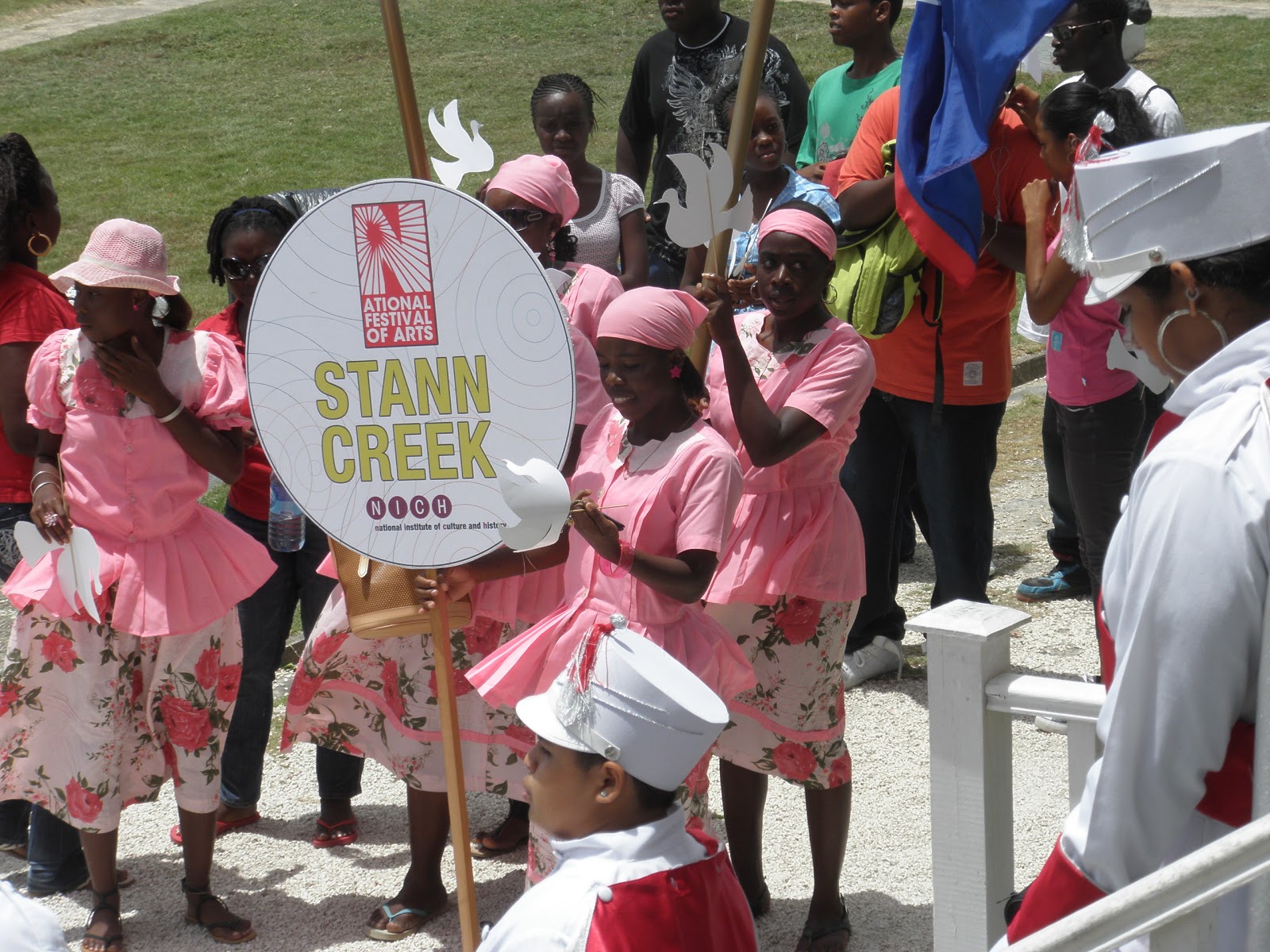
The two days I spent with my counterpart were a special treat.  Instead of sitting in meetings discussing my job description, to my delight, we instead traveled with her boss, the head of the Education Center, to Belize City, 2 ½ hours away, to watch Stann Creek students participate in the annual National Festival of Arts.  On Monday we watched the opening ceremonies outside the House of Culture, sitting along the waterfront of Belize City.  We also took part in a parade through the streets of the city, while the students marched and danced to the beat of the  Garifuna drums.  Each of the six districts of Belize was represented by marching bands or other musicians in the parade.  On Tuesday we returned to Belize City for the second day of the festival to see our Stann Creek students sing, dance and act in short plays in the Bliss Performing Arts Center along the waterfront.  My counterpart and her boss came to see their own daughters perform on stage.  I felt so honored to be able to accompany them and witness the talents of the Belizean students.

After only five days in our new sites we returned to Belmopan for the remainder of our training.  As I write this, I am in the Peace Corps office, with one more week left of training.  On Friday, June 10, we will swear in at the Governor General’s residence, then attend a reception at the American Ambassador’s home.  On Saturday June 11 we will all be dispersed to our permanent sites to begin serving as Peace Corps Volunteers.

Tuesday, May 10, 2011

Mother's Day weekend in Orange Walk and Corozal


Two more weeks of intense technical and language training had passed and we were due for a break from all the work, and eager for the opportunity to experience another part of Belize.  So this past weekend all 38 of us Peace Corps trainees were dispersed to every corner of Belize to visit current Peace Corps Volunteers to see how they work and live.  

I took a bus on Saturday morning to Belmopan, where I connected with Kathryn, another trainee in the education sector, and the two of us caught a bus to Belize City, another 1 ½ hours from the capital.  From there we rode the bus for another 1 ½ hours to Orange Walk Town, where we met Colleen, an education Volunteer who arrived in March 2010.  We brought bike helmets from the Peace Corps office and Colleen borrowed bikes for us to use on a tour around the town.  With a population of 22,000, the largely Hispanic settlement of Orange Walk is the largest town in northern Belize.  The town is a mix of Spanish, Maya, East Indians, visiting Mennonites and Chinese. Mexican influences remain strong and Spanish and Kriol are the most common languages spoken.   It’s even hotter up in the north than down in Blackman Eddy, but it seems to be a little drier, at least for now just before the rainy season begins.  

Colleen organized a “cocktail hour” at her comfortable little apartment on Saturday evening, inviting many Peace Corps Volunteers and Belizean colleagues.   I am so impressed with the way the Volunteers collaborate with one another, even though they work in different sectors.  The photo below shows a world map that a few Business/Organization and Health Peace Corps Volunteers helped Colleen and the children in her school to put on the school’s wall.  The children painted and labeled the map, and Colleen helped the teachers to include lessons in their curriculum to teach world geography.

Colleen is a speech pathologist, but she wears many hats as a Peace Corps Volunteer.  She works with autistic, hearing-impaired, and blind children.  She also trains pre-school teachers in 5 different pre-schools.  She sees many children with speech and language disabilities, and gives workshops around the country to Belizean teachers.  I was so inspired by her.

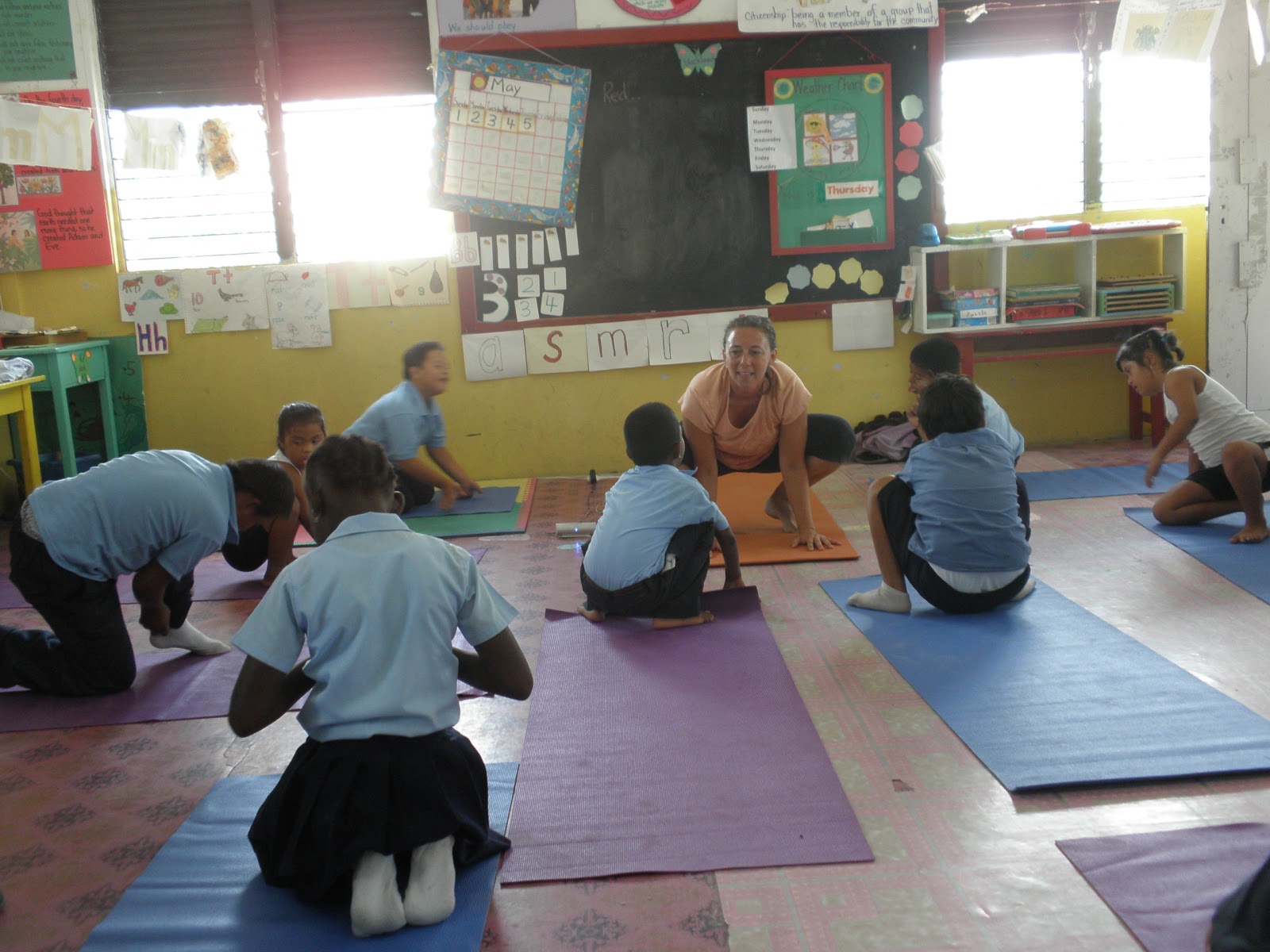
We also had the opportunity to see the work of another volunteer whose secondary project is to teach yoga to students with special needs.  The photo below shows the kids holding a pose described as “the frog”.  Several of the students are children with Down's syndrome.  

On Sunday we hopped on a bus heading for the northern-most town in Belize, Corozal, about an hour and a half away from Orange Walk.  Corozal borders Mexico and sits right on the coast of the Caribbean Sea.  We enjoyed our Mother’s Day afternoon lounging in the shade of the trees along the Sea, while sipping Belikin beer and eating juicy mangoes.  Corozal doesn’t have a large, sandy beach, but we were able to swim in the warm, green Caribbean waters and lie in the shade with sea breezes cooling us.  That evening we ate fresh shrimp ceviche, and sipped Belizean rum.  It was heaven!


On Monday we were treated to a day working at the primary school.  Below is a photo of the pre-school, where I had the opportunity to sing and play with the 3- and 4-year-olds.  I observed in other classrooms, and read aloud to many eager children in the school’s small, but cozy library.  Spending the day in this primary school  inspired me for working in my own assigned schools.  I’m eager to work with the children and teachers in my own site.  


We returned south on Tuesday morning, leaving at 6:00 am when a neighbor of one of the Peace Corps Volunteers offered to give us a lift in the back of his pick-up truck all the way to Belmopan.  Many people here are willing to give folks a ride, because cars are hard to come by in this country, and gasoline is more than $6.00 a gallon.  It felt like riding in a convertible in the hot morning along the Western Highway back to our Community Based Training site.  We have two weeks of training left in Blackman Eddy, with presentations, workshops and projects to complete before we leave our host families and learn our permanent sites.  Then we will complete our training in Belmopan at the Peace Corps office, and will swear in as official Peace Corps Volunteers on June 11, at the Governor General’s home.  I look forward to that “graduation” ceremony, and to beginning my real work here in Belize.

I wish all my friends, family and former students the happiest of days as you enjoy spring and the last days of the school year.  I’d love to hear from you.  Love,  Ava

Sunday, April 24, 2011

Easter Weekend in Belize

From Good Friday to Easter Monday everything in Belize slows down or shuts down.  Few, if any buses run, and most people either go out to the beaches for a 4-day holiday, or stay at home.  This past Friday Diana, Jay T and I relaxed and did virtually nothing all day.  We were following the Belizean tradition for Good Friday of sitting quietly and meditatively until the late afternoon.  That is a very difficult thing for a 6-year-old boy to do.  As you might imagine, he wasn’t very happy about that.  But he managed to make it till the evening, when we had conch for dinner and relaxed some more. 

Holy Saturday is the day for a huge cycling race.  The race begins early in the morning in the eastern end of the country in Belize City and snakes across relatively flat terrain along with Western Highway to the far western end of Belize in San Ignacio, where the racers turn around and traverse the country back again to Belize City.  The length of the race is 140 miles, and all along the highway crowds of people come out to cheer on the cyclists.  We sat along the road in front of Diana’s parents’ house, with cousins, aunts and siblings.  I must explain that this “highway” is the width of two lanes, has no lines painted to indicate lanes, has no stop signs or stoplights.  The racers passed us around 8:30 and we shouted “keep gwain, bwai!” to bolster them.  We sat along the side of the highway till the racers made it out to San Ignacio, turned around, and passed us by again.  The rest of the race was experienced sitting beside the radio as the announcer narrated every inch of the race.  I was immersed in Kriol, and was understanding about 75% of what I was hearing, but could gather from the shouting and excited or disappointed faces what was happening.  Our celebration was enhanced with fresh coconut water just harvested from the trees beside Diana’s parents’ house, cut open with Vince’s machete.  Oh, and the coconut water tasted fantastic sweetened with Belize’s Caribbean Rum.  Lunch was a huge barbequed red snapper, cut and served on fresh, handmade corn tortillas, spiced with ripe tomato salsa.  

Unfortunately for Belize, this year’s cycling race winner was a Guatemalan, followed in second place by an American.  A native Belizean has not won this race for the last 6 years.  Diana tells me that the Belizeans do not have sponsors but work full-time jobs and thus do not have time to train as much as some of the other racers from other countries.  Nevertheless, Belizeans love cycling and this race is an important tradition for the Easter holiday.

In the late afternoon we took a short ride over to Spanish Lookout, a farming community mostly populated by Mennonites, where we went to enjoy an ice cream cone.  The Mennonites have the only diaries in the country.  We stayed to observe an auction that the Mennonite church had arranged as a fund raiser for one of their community who was diagnosed with cancer and needed to raise $75,000 BZ (or about $37,500 American).  There was a car wash, food (including Diana’s favorite, pirogues), and the auction.  Diana’s mother had her heart set on a little Holstein calf, but someone else out bid her.  


On Sunday Jay T was put on the bus to go to church with his little cousins.  They looked so cute all dressed up for Easter!  When Jay T returned we went to search for some plastic Easter eggs with jellybeans that I had hidden.  Then Diana’s aunt took us all to the river to swim and escape from the heat.  Swimming in the Belize River is a beautiful and refreshing experience.

Sunday, April 17, 2011

Weekend Tourist Adventures

April 17, 2011

I had the opportunity to be a tourist this weekend.  Several of us Peace Corps Trainees got together and traveled to two different places.  Fortunately for us, this country is very small, and buses are easily accessed and cheap.  On Saturday six of us met at the bus terminal in Belmopan and hopped on a bus to the Blue Hole where we met up with four others.  The photos here don’t really give this remarkable place justice.  It is a national park with hiking trails and a swimming hole that is fed by a natural spring, trickling into a limestone sinkhole.  The color is a brilliant turquoise, and the water feels so refreshing in this 90 degree plus heat.  We hiked for about a mile on a well-marked trail through the jungle, and relaxed while eating our picnic lunches.  It was a beautiful day!
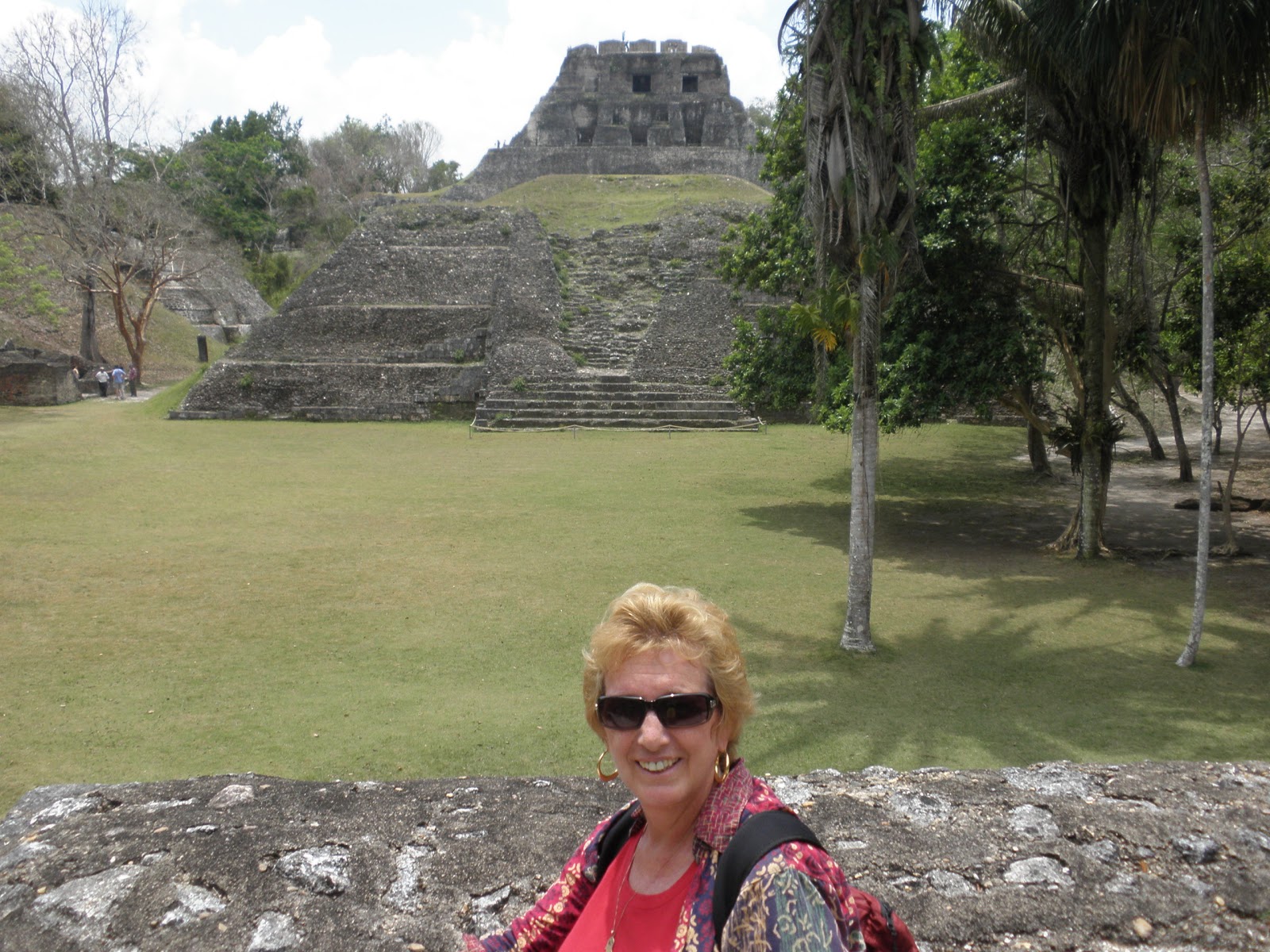
On Sunday, a few more of us made our way by bus out on the Western Highway past the relatively large town of San Ignacio, to a quaint little village called Succotz.  From there we took a ferry across the Mopan River and hiked about a mile to the Mayan ruins of Xunantunich (pronounced “shoo-nahn-too-neech”).  This archeological gem is from the Mayan Classic period (300-900 AD).  It has a ceremonial center, with large plazas ringed with pyramids. The tallest is the 130 foot "El Castillo," which is large by Mayan standards and is only exceeded by the Caana pyramid at Caracol, which I also hope to visit one day. The site was occupied until around 900 A.D. and was likely abandoned after an earthquake, the evidence of which was discovered by archaeologists in the mid-1900's.  After climbing to the top of El Castillo and taking these photos, we hiked back down while listening to the howler monkeys in the trees.  These monkeys (referred to by the Belizeans as “baboons”) are large and produce a loud “howl” or growl.   Howler monkeys are widely considered to be the loudest land animal. According to the Guinness Book of World Records, their vocalizations can be heard clearly for 3 miles (4.8 km).  The males use their howls to warn other males to stay away from their territory.  Unfortunately, my photos of the howler monkeys do not show them very well, so I didn’t include those pictures.  They hide themselves well in the tall trees.


From atop the pyramids of Xunantunich we were able to gaze out on Guatemala.  We returned to the village of Succotz and ate our lunch in a little outdoor restaurant called Benny’s and then caught a bus back home.  Now I’m relaxing on a Sunday evening, enjoying the cool evening breeze and getting ready for a busy week with lots of work in our technical and language training sessions.  I wish all my family and friends a wonderful Passover and Easter this next week.  Love,  Ava

Saturday, April 9, 2011

Belizean politics again

Once again I’ve been immersed in Belizean politics, local and national, all in one day, this past Friday.  Every Friday during our 8 weeks of training we are required to travel to Belmopan to the Peace Corps office for training with all 38 of us who are scattered in our separate villages.  During this training session, we were treated to a lively lecture on Belizean history and politics by Senator Hulse.  He has been involved one way or another in Belizean politics since the inception of this young country in 1981.  He regaled us with stories of the British loggers who first settled here with their African slaves in the 18th century, and explained the intricacies of the continuing conflicts with Guatemala over Belize’s western border.  We learned of the Garifuna and the Maya who continue to maintain their unique cultures in this polyglot nation.  He even brought us up to date on the conflicts between Chinese merchants in Belize City and the Creole gangs who recently murdered a Chinese immigrant.  Generally, though, all the various linguistic and cultural groups here in multicultural Belize tend to get along well, and the Senator emphasized that Belize has never been subjected to the brutal dictatorships and military coups that other Central American countries have suffered.  Belize has a strong, vibrant democracy, and if what I’ve experienced so far in the short time since I’ve arrived is indicative, the populace is actively involved in the governance of their villages, towns, cities and the nation.

The same day as my history/politics lesson with the Senator, I experienced firsthand the messy nature of direct democracy.  That evening Diana had called an emergency meeting in the village’s community center to address some rumors and complaints that had been circulating.  To my surprise, she asked me to come along for (what I thought was) the purpose of observing and getting to know some of the villagers.  Little did I know that a few seconds after 70  or so people arrived, she would involve me in her village’s disputes and conflicts that have been seething under the surface for generations.  She began the meeting and asked me if I would translate into Spanish for the 20 or so villagers who don’t understand English, and I eagerly agreed, not realizing that I would soon be translating the angry words of several who aired their long-standing grievances in odious tones. As a Peace Corps Volunteer, it is imperative that I remain neutral, so my role as translator was merely to restate in Spanish whatever each speaker was trying to convey, without emotion or editorial comment.  What a challenge that was!  I was never quite sure I completely understood the entire story behind the complaint the speaker was voicing, so I simply translated as many words as I could retain in my head while the speaker angrily spoke.  I was translating for the elderly Spanish-speaking people who were curious about each emotional outburst expressed by their English- and Kriol-speaking friends and neighbors.  Afterward they shook my hand and thanked me for helping them to understand, although I remained slightly unclear about the details of each of the conflicts.  As far as I could ascertain in the heat of the meeting itself, the disagreements involved who could sign off on checks from the community’s account, who had the authority to make the decision concerning the installment of electricity in the community center, and finally, and most hotly debated, who would decide the allocation of plots of land within the village.  Diana calmly explained each issue to the villagers, but I had to continually remind her to slow down so that I could translate.  I was exhausted after a couple of hours.   Many of the villagers apologized to me for having been subjected to such unseemly behavior, as they put it to me, but I reassured them that the process of working through conflicts is universally difficult and untidy.  I reiterated to them that I’m enjoying being in their beautiful country, and that I was merely witnessing their democracy in action.  I expressed confidence that all of their concerns would be resolved because of their passionate participation.   Later, in Diana’s home, we stayed awake until 1:00 am as she narrated in detail the history of the community discord, and especially the personalities involved in the long-standing disputes. 

I hope the rest of my encounters with the villagers will be on more neutral territory, and I especially hope that I can contribute something positive to the little elementary school that has been assigned to our Peace Corps group while we’re training here. 

I also hope that all my friends, family and former students back in the US are enjoying the emergence of spring.  Here in Belize we're suffering the sweltering heat of summer.  Lots of love, Ava

Thursday, April 7, 2011

Week 2 in Belize


On Friday, April 1 we Peace Corps Trainees were driven to our Community Based Training sites.  Four of us in the education sector will train in the village of Blackman Eddy for the next eight weeks.  The Peace Corps SUV pulled into my new little village and dropped me off at the home of my host family.  I was welcomed into the home of Diana and her son JT,  a rambunctious 6-year-old whirlwind of a boy whose smile brightens up the room when he enters.  Shortly after meeting JT, I brought out my deck of UNO cards and he quickly caught on to the rules of the game.  We’ve played about 50 games so far, although we have to alternate between sessions outside playing ball and swinging.  Spending time with him brings me back to my fondest moments with Michael when he was six.  He has the same energy and level of engagement with adults. 

His mother, Diana, is equally energetic.  She’s a political and civic powerhouse in this little village, where she grew up and where most of her siblings, cousins, and her parents still reside.  She studied at the University of the West Indies in Belize City, and spent two years studying at a university in southern Illinois, and is now committed to working in her community to improve conditions and services for all.  She is the village chairperson, (a little like a mayor), and she is extremely active in her political party.  Many people of the village drop in to visit her throughout the day, and it seems she is a kind of village Solomon of sorts as well, and intercedes on behalf of families who need advice or assistance.   I had the privilege of traveling with her all afternoon on Saturday, April 2, observing as she met with leaders in various villages of her region in preparation for her party’s convention the next day.  On Friday evening and Saturday morning she conducted meetings with various women in her village and all took on jobs organizing, stapling, labeling, and dispensing materials for the convention, which determined the party’s candidate for Regional Representative in the next national election.   On Saturday evening we drove down to San Ignacio to pick up a large van that was used to transport voters to the convention, and we drove to the village of Roaring Creek so that Diana could pick up several hundred t-shirts in her party’s color (red) that prominently displayed the name of the candidate.  Diana, the tireless political activist, barely slept and then arose at 4:00 am to begin her day’s task of transporting and feeding as many of the registered voters as she could bring to the convention in Roaring Creek.  I guess that’s one way to guarantee a large voter turnout.  Diana said that 1/3 of the possible voters came out to vote.

Around 4 PM Diana’s brother picked me up and transported me to the convention so that I could witness democracy in action in Belize.  It took a while for me to locate Diana among the hundreds of voters and vociferous supporters of the 3 candidates.  Diana’s candidate had the largest number of supporters, and was by far the most vocal, booing when the rival candidates attempted to speak to the crowd, and almost coming to blows with supporters of the other candidates.  And this is all within one party.  I wonder how the behavior would be if they were in the same vicinity of the rival party.   While we were waiting for the votes to be tallied, I had the opportunity to meet and speak with the Attorney General of Belize.  He taught me a great deal in a couple of hours about the political system of Belize and its two major parties, which seem to be just as far apart from one another as our Democrats and Republicans, and treat each other with just as much animosity.

Our site training began in earnest on Monday, April 4.  We four trainees meet at the community center Monday through Thursday from 8-5, and travel to Belmopan to the Peace Corps office on Fridays.  Our wonderful Kriol language teacher, Shernadine, teaches us for half of the day, we walk home for lunch, then return for “tech” training to learn the specifics about doing community work and teacher training in the Peace Corps.  Training is incredibly intense and the work load is very heavy, but luckily I have plenty of time in the evenings at Diana’s house.  On two occasions we trainees went to the local primary school to meet with the principal and teachers.  We were each assigned to work with a classroom during the 8 weeks we are here in Blackman Eddy.  I’ll try to get some pictures of the school up soon.

We are required as trainees to work on a special project with the school, one that can be competed in our off hours or weekends.  Miguelina, one of the other trainees, a former principal and teacher from Upstate New York and I are planning to help get the school’s library in order.  At present there are a few piles of books in a little room that has already been decorated with paintings on the wall.  It seems that it just needs some organization.  The principal expressed a desire for help with this project.  I may soon be requesting children’s book donations from some of you.  This little rural school has a dearth of decent children’s literature.

On one of our school visiting days, I was assigned to observe a Standard 2 (3rd grade) classroom.  The teacher has 30 years of experience and she does wonders with very few materials.  The kids are crammed in a little space of a classroom, but they all eagerly raise their hands when the teacher asks them a question.  I followed the 17 smiling, curious 8- and 9-year-olds (and one 12-year-old) outside to observe them acting out a little folk tale they had read in their readers.  Little Brian got down on all fours to portray the donkey, while Tyrique stood with his arms out depicting a tree.  My favorite little one, Eva (for obvious reasons!) read the narrator’s part with great expression.  The kids all call me Miss Ava (sounds like Mees Ava), and are eager to show off to me.  About half of the class comes from Spanish-speaking families, but all speak Kriol and English.  On Monday the 11th I will return to the class and the teacher has asked me to read a story to them.  I searched on the small pile of torn and well-used books that she had for them to choose from, and found one possibility, but I also hope to get up to Belmopan this weekend to try to find a picture book to read to them and donate to the class.  When I think of all the gorgeous picture books we had in the schools I taught in the US, I wish I could give these Belizean kids even a tenth.  After the students finish their written work they eagerly search for any kind of reading material they can find and read voraciously on their own—without anyone even forcing them to do so.  They even read ahead in their boring, dull textbook readers just to have something to read.  Oh, and there’s no public library in the village.

I’m having great fun reading aloud to JT at home at night, and telling him stories.  He has some stuffed bears, so our first story was “The Three Bears”, which he asked me to tell him over and over again.  He is a very articulate and bright 6-year-old who is affectionate and engaging.  One night I completed my language homework by conducting an interview with him in Kriol, which he kindly pronounced as “very good.”  I found a Kriol version of “The Wheels on the Bus” and he now wants to sing it a thousand times. 

The greatest pleasure I have experienced here so far has been meeting, getting to know and spending time with the Belizean people.  The most challenging aspect of my work here so far is the amount of projects we’re expected to complete.  And the most physically challenging thing has been acclimatizing to the extreme heat we’re experiencing.  However, the temp today is a little milder than it has been, 86 degrees, and 66% humidity.  Maybe I’ll actually be able to sleep tonight!

I send love and hugs to my beloved friends, students and family.      Ava