Sunday, March 4, 2012


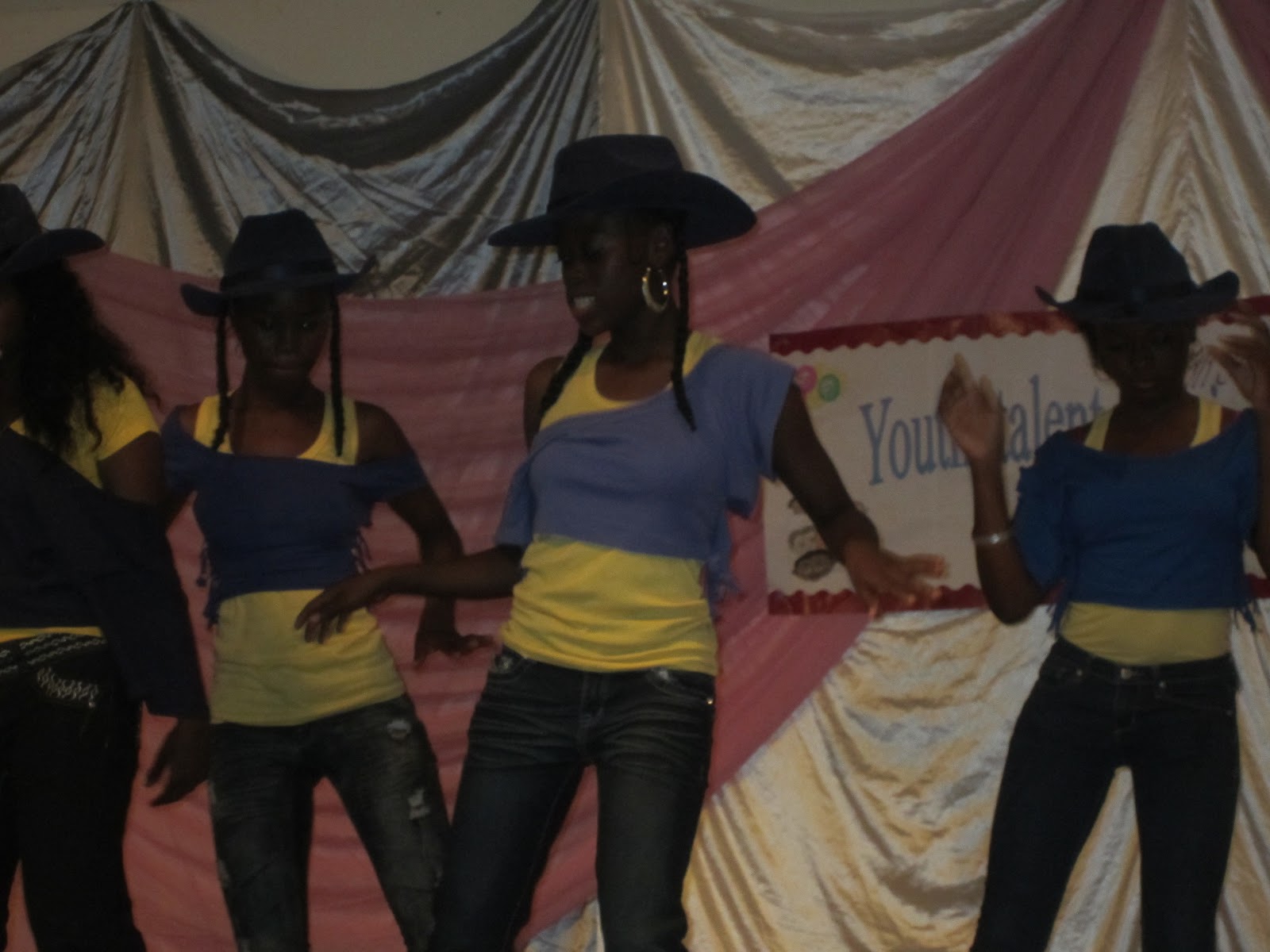
February was for me a month of relatively consistent work in the schools with only a few interruptions to my schedule.  Interruptions are actually quite common here in Belize.  It seems there are frequent fairs, fund-raising events, parades, festivals, contests or teachers gone from classes due to workshops or retreats.  But this past month I only really experienced two interruptions to my regularly scheduled sessions with students and teachers.  One was a spelling bee which I was asked to help judge, and another was a Festival of the Arts for high schoolers which I was asked to help decorate and run.  The spelling bee was held in several locations throughout the Stann Creek District, to determine the winner who would then compete in April in order to be the representative of the Stann Creek District overall in the national spelling bee held in Belize City.  The Festival of the Arts is also an elimination contest to determine the best in the Stann Creek District who will eventually complete in the national festival in June.  What a privilege it as for me to be not only an observer of the Belizean students’ talent, but also an active participant in organizing these contests.  Here are some photos of a few high school performers. 
High School students dancing the traditional Garifuna dance, Jankunu
Belizean rappers
Traditional Garifuna dance
The winning dance competitors
As I continue to work with small groups of students, teaching them how to read, and as I attempt to give teachers ideas for working with these underachieving students, we are all beginning to see some progress in their development.  As the teachers notice their students’ progress in reading and their developing confidence, they are encouraged to work with these small groups of students on a regular basis.  The traditional mode of instruction in Belize has always been whole-class, regardless of whether or not individual students are progressing, so the notion of working with small groups (known as differentiating instruction in educational parlance) is a relatively new concept.  It is also very difficult to implement in the schools, because there is little physical space inside the classroom to group students according to ability level.  I have taken to pulling small groups of kids outside to work a half hour at a time, or to working with teachers before or after school with these small groups.  We have seen the students progress in their reading abilities just since November.  That is very encouraging to teachers.

Teaching a small group of Standard I (second grade) students at Light of the Valley Primary School

Every Wednesday I also continue with the Family Literacy workshops in the Spanish-speaking village of Bella Vista.  Two of the mothers have learned to write their own names for the first time and are beginning to learn to read in Spanish.  I love working with these women, who dutifully complete their homework and show up each week eager to become literate.

On Saturday, March 3rd I did some hiking with two friends, Eva and Linda at the Cockscomb Basin Wildlife Sanctuary and Jaguar Preserve.  This unique sanctuary in southern Belize covers an area of about 150 square miles of tropical forest, and is the world's only jaguar preserve.  The jaguar is largely a solitary, opportunistic, stalk-and-ambush predator at the top of the food chain (an apex predator) and it is a keystone species, playing an important role in stabilizing ecosystems and regulating the populations of the animals it hunts.   Belize declared the Cockscomb Basin Wildlife Sanctuary a preserve in 1984, and the jaguars within its boundaries have been protected ever since.  We did not encounter any jaguars, since they are nocturnal.  We did, however,  glimpse a grey fox, a jaguarundi, a guinea fowl and two snakes.

 
After a rather strenuous climb, we were rewarded with two waterfalls and a pool of water in which to cool ourselves off.  We were also treated to a view of the Cockscomb Mountain Range, and Victoria Peak, the second highest mountain in Belize, at 3,688 ft.  I am so blessed to be able to witness this tropical, Central American beauty.
along the trail
Victoria Peak

Sunday, January 29, 2012

January 2012-- December Vacation in the States and New Year News


I was re-energized for this New Year by traveling to the States over the December holidays.  I visited my mother and cousins in California, spent a couple of days with my close friend, Maureen, in Binghamton, went to a Syracuse basketball game with my son Michael and his girlfriend, Maeve and spent the rest of my vacation with Michael and all my beloved in-laws in the Catskills.  Before this visit to the US I had been dealing with recurring attacks of homesickness, and this short trip was exactly what the doctor ordered to give me strength to keep going.  The love of family and friends, and their excitement and interest in my experiences here in Belize were like water to my thirsty soul.  Loneliness and homesickness are very common experiences for Peace Corps Volunteers, and we appreciate every letter, email, phone call and package sent our way to help buoy us when those feelings threaten to overwhelm us.  Thank you.
My mom and I visit the Getty Villa in Los Angeles
Maeve, Michael and I attend a Syracuse University basketball game

Upon returning to Belize, there was still a week of vacation left before school reconvened, because schools are closed for three weeks during the Christmas holidays.  So I used the time to begin preparing a workshop on phonics that I will soon deliver to teachers.  I met that week in Belmopan with my Peace Corps colleagues who are also literacy volunteers and we shared ideas and materials and inspired each other.  Then school began again in earnest.  After several months in the fall of observing teachers in schools, attending meetings, and dealing with my own illness and hospitalization, I am finally visiting schools on a regular schedule, meeting with the same teachers every week at the same schools.  In our training sessions Peace Corps had explained to us that it would take a good six months of observation and getting to know the principals, schools and teachers before we would find a niche.  I now see the wisdom of taking it slow and establishing rapport.   After Christmas vacation, when I returned to the schools, the principals and teachers welcomed me back with great warmth.  Several teachers approached me to ask for help with ideas, testing, and intervention for students who are reading below grade level. At all of my schools I have groups of students I tutor in reading, while teachers observe, and I give the materials and ideas to the teachers so that they can work with the children when I am not there.  I also work with parents in an adult literacy class in Spanish.  This work is challenging and fulfilling and I hope I will make at least a little bit of difference for some Belizean children and teachers.

My exciting news for this month is an important move that I made:  I finally moved into my own apartment.  I enjoyed living for seven months with my host family, Miss Cas and the kids, but I was also eager to move into my own place with more room to move around and finally get my clothes out of suitcases.  My new place is the bottom floor of a kind of duplex.  Many homes in Belize are built with one dwelling on the ground floor and a second home in the upstairs part of the house.  The previous tenant was another Peace Corps Volunteer, Kirstin, who recently completed her third year of service and has returned to the US.  Kirstin served for two years in Burkina Faso, and then extended for a third year here in Belize.  We enjoyed sharing ideas and activities with Kirstin and will miss her company.  I am thankful to have the opportunity to move into the apartment that Kirstin used, as it is furnished. 
Dangriga Peace Corps Volunteers Steve and Cathy Burnham, Kirstin McCabe Krudwig, Meghan VanDeventer and me at Kirstin's going-away party

The house is directly across the street from Alejo Beni Park, and just one home away from the Caribbean Sea.  I can hear the waves gently lapping along the coast from my open windows.  My new landlady, a widow named Sandra Garrett, is very kind and eager to share her knowledge of Dangriga with me.  She has given me tips on where to shop for the best bargains for food.  She has a dog, Sparky, who is really just an overgrown puppy, rambunctious and impossible to calm.  Dogs in Belize are primarily used as watch dogs, and are kept outside.  Sparky is kept on a lead and has a dog house to shelter him from the rain. 
My house (I'm on the bottom floor)
My kitchen and living room
My bedroom and bathroom
Sparky, our "watchdog"
Alejo Beni Park, across the street from my house
Standing in front of my house, looking toward the sea

This is a new phase of my service here in Belize.  Having my own place means cooking for myself and having the opportunity to host guests.  Last weekend I hosted three people from the US, Canada and Denmark who facilitated a workshop for teachers on storytelling and creative writing.  I enjoyed cooking for my visitors and assisting them with workshops that are beneficial for Belizean teachers and students. In my new home I also enjoy having the extra space to spread out the materials that I make almost daily to use in the classroom.  Teachers here do not have many resources, and make most of the simple games, flashcards and charts that they use in their classroom, from cardboard, markers, glue and laminated with many strips of clear plastic packing tape.  Every day I work on these materials to share with teachers and to use in my own tutoring sessions.

The following are more photos of my town, Dangriga.  I hope you enjoy this little tour:
Dangriga's version of Home Depot, Habet's Hardware
Homes in Dangriga are either made of cement, like mine, or wooden, like this one.  Most of the streets are unpaved.
The offices where I meet with my Ministry of Education colleagues
The Dangriga post office
Dancing to the Garifuna drums around the corner from my house at the newly opened inn, Sea Breeze

Full moon in Dangriga

Thursday, December 15, 2011


December 2011
Participating in all activities that our District Education Centre Office supports is one way to integrate into my community and help out my colleagues in the education field.  On the second of December I participated in a parade here in Dangriga to commemorate National Disabilities Awareness Day, sponsored by NaRCIE, the National Resource Center for Inclusiveness Education.  The parade through the streets of Dangriga was the culmination of week-long activities designed to sensitize parents, teachers and students to the existence and needs of students with physical and developmental disabilities.  I helped carry the NaRCIE banner, walking behind a Dangriga fire engine blaring its siren.  Behind us were students from many schools in Dangriga, including several Special Education students from the one school in the area where there is a center devoted to working with children with either physical or learning disabilities.  Most children in Belize who might qualify for special education services are not able to receive assistance from a specially trained teacher, but the Ministry provides a trained special education coordinator for the entire Stann Creek District who travels to all 38 schools to support teachers in their efforts to include students in regular classrooms.  Here in Belize “inclusion education” is the norm. 
 My colleagues from the Ministry of Education, Therese, Ora and Tanya
Marching in the parade
The beginning of December marked our ninth month since arriving in Belize, but only the sixth month of our service as sworn-in Peace Corps Volunteers working in our permanent sites.  At this juncture, the Peace Corps brought all 36 of us together for a “Reconnect” and “In-service Training”.  The first day of our week together we traveled to Belmopan with our Belizean work partners for a workshop on developing our work plans based on a participatory analysis of our Belizean partners’ needs and goals.  The following two days were spent with our fellow Peace Corps Volunteers in workshops ranging from “Stress Reduction” to “Budgeting”.  We received even more training in “Safety and Security,” a major concern for Peace Corps worldwide.  We reread and recommitted to our original goals and expectations, and generally commiserated with one another by sharing our successes and challenges.  On the last day several Peace Corps Volunteers stayed in Belmopan for optional language training.  The original teacher who had worked with the intermediate and advanced Spanish learners during our three months of training was not available, so Peace Corps asked me to step in.  I was thrilled!  I was given the enviable task of designing and teaching a 4-hour immersion class in Spanish to ten of the most motivated students I have been given the privilege to work with.  Imagine ten confident, eager, driven, animated adults who are clamoring to learn to speak Spanish in order to work with students, parents, hopeful entrepreneurs or villagers.  It was a Spanish-teacher’s dream class.  We reviewed practical uses of grammatical constructions and applied them to communicative situations Peace Corps Volunteers might encounter in their sites.  We read Pablo Neruda’s poetry and an article in the Spanish version of Cosmopolitan magazine.  We listened to music, and learned lyrics to children’s songs.  Our 4-hour class culminated in a spontaneously-acted telenovela (Spanish soap opera), based on the descriptions of a tangled web of characters devised by this diabolical instructor.  I had a blast!  Feedback from my fellow PCVs showed a desire to receive continuing instruction of this kind in the future.  All will depend on our ability to come together in a central location for such an endeavor.  I hope Peace Corps will grant us that opportunity again.

In my primary project with the schools I continue to work with small groups of students who are struggling with reading.  I also conduct workshops for teachers and instruct them in ways to differentiate their classrooms to include the students who are not on grade level in reading.  One of my most enjoyable experiences in the school of Nuestra Señora de Bella Vista has been helping to conduct the bi-monthly Family Literacy Workshops.  Mrs. Juanita Batun, the Literacy Coach from the Ministry of Education in Belize City, had asked me to work with her to develop workshops for the parents of students in the village of Bella Vista, so we began in early November to conduct these workshops with 60 parents, mostly mothers.  The majority of the participants are recent immigrants from Guatemala, Honduras and El Salvador, speak only Spanish, and many have not learned to read in either English or Spanish.  Mrs. Batun was able to secure a grant in order to provide materials for the parents, and she asked me to be her translator.  We have conducted five workshops so far, teaching the parents the alphabet in English, instructing them in the importance of working with their children at home, and providing materials that they have constructed with glue, scissors, paper and fabric in order to work with their children at home.  We have been pleased with the enthusiastic attendance and the teachers remark that many parents are beginning to feel more comfortable visiting their children’s classroom.  Our goal is to encourage the parents to be as involved as possible in their children’s education.  It’s quite a challenge in this little village, with no library, no bookstore, and few opportunities for the families to enrich their children’s education.  Most of the parents are either employed in small cottage industries, or work in the banana farms.  They are some of the warmest, more welcoming people I’ve met here in Belize.
I'm helping out by holding the baby while the mothers sew "reading mats"

Every Wednesday when I travel to Bella Vista I travel on the teachers’ bus at 6:00 am, travel and hour and a half to get there, and leave at 4:00 pm to arrive home at 5:30.  This past Wednesday, however, I remained at the school in the evening to help out with the Christmas Pageant.  All schools in Belize are expected to raise most of their own funds, by charging a small fee at the beginning of the school year, and by conducting many fund-raising activities throughout the year.  The Ministry of Education only funds the salaries of the teachers and distributes textbooks; the individual schools must raise all other funds.  The Christmas Pageant was one such fund-raising endeavor.  I helped to sell snacks and drinks while watching the children perform songs, dances, poems and skits.  Here are some photos:
Bella Vista Christmas Pageant

And here's my favorite little "host brother", Shemar:

Wednesday, November 23, 2011


November 19, 2011       Garifuna Settlement Day

Before describing the celebrations of Garifuna Settlement Day, I offer here a brief description of Garifuna culture and history:   

Herded aboard slave ships in West Africa, a group of Garífuna forebears were likely destined for New World mines and plantations when they wrecked off the Caribbean island of St. Vincent in 1635.  They found refuge with the island’s Carib and Arawak Indians, immigrants from South America.  The two peoples blended through marriage, creating the Garífuna culture—Caribbean fishing and farming traditions with a mixture of Native South American and African music, dance, spiritual beliefs and language.

The Garínagu (Garifuna people) prospered and coexisted peacefully with French settlers who came later in the 17th century. Then English colonists began to arrive and demand land. The tensions eventually turned to war. Hopelessly outnumbered by British troops, the Garíngu and their French supporters surrendered in 1796. The British exiled the Garínagu to the island of Baliceaux.  They were imprisoned there in appalling conditions, and more than half died. The following year survivors were shipped to Roatán Island off the coast of Honduras. According to legend, the Garinagu hid cassava, a mainstay of their diet, inside their clothes, where it stayed alive watered by the sweat of the tightly packed captives. They planted the cassava on Roatán, where it grew abundantly. Soon the Garínagu established fishing villages along the coasts of Honduras, Nicaragua, Guatemala, and Belize. Each year in Belize, when locals reenact the arrival of the Garifuna people in 1832 to Dangriga, they slip out to sea in boats, then ride the surf onto shore, waving palm fronds and banana leaves to symbolize the plants that sustained their ancestors. This ritual, rich in music and dance, helps sustain Garífuna culture.
Sunrise in Dangriga on Settlement Day, November 19, 2011

Reenactment of the landing of the Garinagu in Dangriga

Me in my Garifuna dress with Marie and Michelle

Me with Miss Cas, Jemeiah and Shemar outside the church after Garifuna mass
Drumming, dancing and singing Garifuna songs

The Garifuna language is losing ground to English and Kriol, but the National Garifuna Council and schools such as Gulisi Primary School encourage young people to maintain their language, culture and music.  Each year in November in preparation for the Garifuna Settlement Days, several towns with large populations of Garifuna people hold pageants to determine contestants for the Miss Garifuna/Belize final pageant.  The winners of each town’s pageant are young women who best exemplify the values of the Garifuna people.  The judges interview these contestants, who also must perform traditional dances, reenact scenes from daily life in short skits, and give a speech in Garifuna.  I was present for the final pageant in which Miss Garifuna/Belize was chosen for 2011.   
Miss Garifuna/Belize Pageant 2011
Garifuna Settlement Day Parade

Pen Cayetano and the Turtle Shell Band


During the week leading up to Settlement Day, November 19, there are many contests, musical presentations, feasts and celebrations in the schools.  However, I was unable to participate in these this year, as I was treated for pancreatitis in the hospital in Belize City for those five days.  My colleagues in Dangriga filled me in on what I had missed, and welcomed me back home when I returned on Friday, November 18.  That evening there were parties throughout Dangriga, with drumming, dancing and a lot of drinking.  Hundreds of visitors flock to Dangriga each year on that night to party all night long and stay awake until dawn on the morning of the 19th to witness the reenactment of the settlement of Dangriga. Due to my recent hospitalization, I was unable to participate in the all-night party, but I was present for the 6:00 AM sunrise reenactment, the parade and the Garifuna mass.  I hope to participate fully in next year's festivities.

Sunday, November 6, 2011


Two Trips to the Cayes
This past week I was fortunate to have two opportunities to visit three cayes that are just off the coast here in Dangriga.  Cayes (pronounced “keys”) are ramparts that consist of chunks of dead coral and other debris that form on the windward edge of the coral reef platform.  Some have a small sandy beach, and grow coconut palm trees and mangroves.
Leaving Dangriga behind
Heading out to the Cayes with the students

On November 3 I was invited to help chaperone a group of 20 Dangriga primary school students on a field trip to the cayes.   About a half an hour by boat from Dangriga are several cayes, only a few of which are inhabited.  Our group traveled to three of these cayes with a young marine biologist from Canada, named Donald, who lives and works on the most densely inhabited, Tobacco Caye. 

Red Mangroves

We first landed on Twin Cayes, where there is a station for a couple of Belize Fisheries Ministry officials.  Their job is to patrol the waters of the Marine Preserve to insure that the fishermen take only the species allowed by Belizean law, and only the prescribed number of conch, lobster and fish so as to not upset the delicate balance of the ecosystem.  Donald led us around the caye teaching us about the mangrove forests and sea grass that filters the silt that travels from the mouth of rivers and empties into the Caribbean Sea.  He showed us the three types of mangroves that grow on Twin Cayes and the children were taught to identify them and describe the importance of the mangroves for the health of the coral reef. 
Brown boobie (in mangrove tree); the great frigatebird (flying)

Our next stop was Man-o-War Caye, which is a bird sanctuary.  Donald explained to us that we would not disembark, and we should not make any loud noises or sudden moves.  We had arrived during the mating season.  The two species of birds that inhabit this caye are the brown boobie and the great frigatebird, two birds that live in a symbiotic relationship with one another.  The great frigatebird does not dive into salt water, so it eats the left over parts of fish from the brown boobie’s catch.  We witnessed the mating rituals of the great frigate bird, especially the inflation of the male frigate’s huge red throat pouch that is especially designed to attract females. 

Tobacco Caye
The students from Gulisi School drumming and singing on Tobacco Caye
Time for swimming
A fishing vessel passing Tobacco Caye

Our third destination was Tobacco Caye, the most densely populated caye off the coast of Dangriga, with a population of around 20 people.  There are a couple of small tourist hostels, but no hotels, shops or resorts.  Tobacco Caye is about the size of an American football field, but only a few buildings have electricity from generators or solar panels.  The students found some drums and maracas, and immediately made their own music.  They also enjoyed swimming and canoeing for a few hours before we were whisked away back to Dangriga.
My Ministry of Education colleagues at our retreat on Tobacco Caye
Hanging out with my colleagues on Tobacco Caye

I returned to Tobacco Caye two days later for a retreat with my colleagues from the Office of the Ministry of Education in Dangriga.   Our retreat was facilitated by a Catholic nun, Sister Caritas, who led us in a workshop designed to improve our ability to work as a team.  We were fed a wonderful meal of red snapper and had a few hours of R & R together before we had to return to civilization.  I am fortunate, indeed, to have these opportunities to visit and explore the beauty that is Belize.

Friday, October 14, 2011


October, 2011

The school year is finally in full swing.  In September Belizean school days are so frequently interrupted with national holidays, children’s rallies and teachers’ union meetings that not much gets started in the schools until October.  Now that October is here, I am busier than I have been since arriving in Belize.  I have been assigned to five schools in the Stann Creek District that are piloting a literacy program, and I have spent the last month learning how to find the buses to travel out to these schools and getting acquainted with the teachers and principals. 
  
I will describe what my weeks have looked like for the past month, but by the time you finish reading this blog post, my schedule may have changed.  I will continue to meet with teachers and principals to determine which schools and teachers need assistance.

On Mondays I travel by teachers’ bus to Hope Creek Methodist School.  I should explain that most of the schools in Belize are managed by churches.  There are a few government schools, but Christianity is the official religion of Belize, and Christian prayers are recited even in the government schools.  There is an official prayer of Belize, and in all schools students and teachers pray and study religion in the mornings as part of the curriculum.  The government of Belize pays the salaries of all teachers of Belize (except for a few exclusively private schools), no matter the denominational affiliation, so all schools are under the auspices of the government’s Ministry of Education while most are administered by various denominations of churches.  This is difficult for our American minds to grasp, but there is no separation of church and state in Belize. 

The teachers’ buses that I ride out to the schools are cast-off ancient, rickety American school buses that pick up all the teachers who live in town, and transport us out to the villages.  The village of Hope Creek is only about nine miles from Dangriga, so it doesn’t take me very long to get to the school on Monday mornings.  I leave at 7:15 and begin working with the teachers and principals.  At Hope Creek there is one young teacher completing his internship so I am considering working with him.  Only a small minority of teachers in Belize have a Bachelor’s Degree, another small number have an Associate’s Degree, some have a smattering of training in Internet-based and summer courses, and an even greater number of teachers have only a high school diploma.  Recently the Ministry of Education made it mandatory for teachers to receive their certification within five years of beginning their teaching career.  As a Peace Corps Volunteer I am expected to work with both experienced and new teachers to promote the development of literacy. 

In the little school in the village of Hope Creek there are many students who enter the primary grades speaking little or no English.  On one Monday while I was there, three little Guatemalan siblings were registered by their mother, and neither the 9-year-old, nor the 8-year-old, nor the 6-year-old had ever stepped inside a school.  Belizean schools have many challenges in addition to language barriers.  There are few resources, especially in the villages, where there is less likely to be a public library than in the towns.  In fact, there are few bookstores in Belize, so schools rely a lot on donations of used books from the States, Great Britain and Canada.  The Ministry of Education does provide text books in all subjects to the students, but children must bring their own pencils, notebooks, crayons, and some schools expect them to bring toilet paper and copy paper for the teachers to have in their classrooms. They must all wear uniforms.   None of the schools with which I work has a school library, although some teachers accumulate their own picture books and storybooks and display a small classroom library.  One of my five schools has no functioning copy machine.  Only one of the five schools has internet access, and most of the students have no access to computers either at school or at home. 

On Tuesdays I board a different teacher’s bus at 7:15 and travel to a more distant village in a lovely little valley up the Hummingbird Highway.  This is a Baptist school, with the enchanting name of Light of the Valley.  Here I have begun to help a Standard 2 (third grade) teacher learn how to assess the reading levels of her students.  She has a group of children who are significantly behind the rest of the class in reading, and has asked for assistance in developing intervention strategies for improving their literacy skills.  At this same school I am also working with a young teacher who is beginning his first year of teaching Infant 1 (Kindergarten).  There is another Infant 1 teacher in the school who is a very effective teacher, and so I substituted for this beginning teacher so that he could observe this other model teacher and learn from her.  He reported that he learned a great deal from observing her, and they now are planning lessons together.  What I learned by substituting for him was that this young teacher has a challenging job.   Two of the children have special needs, and one has Down Syndrome.  I spoke Spanish to the children who didn’t seem to understand the story I was reading, and discovered that over half of the class is non-English speaking.    After my attempt at substituting for him, I gained a fresh understanding and respect for the challenges he faces each day. 
Morning assembly at Light of the Valley Baptist School
Miss Logan's Infant 1 class at Light of the Valley Baptist School

Wednesdays are my longest days.  I board the teachers’ bus at 6 am and return at 5:30 pm.  The Roman Catholic school of Our Lady of Bella Vista is in a village 1 ½ hours from Dangriga.  With a student population of 995, it is the largest primary school I am working with.  The Literacy Unit to which I am assigned focuses on Infant 1 to Standard 2 (Kindergarten to Third Grade), and in Bella Vista that means 14 classes.  This village grew up quite recently around the various banana farms that are in the southern region of the Stann Creek and the Toledo Districts.  The banana workers are mostly Guatemalan and Mayan, the languages they speak are Spanish and Q’eqchi, and the population is very transient.  Both parents (if there are two parents) work long hours on the banana farms, and children are frequently unsupervised at home.  The teachers at Bella Vista report that this situation has created a lot of vandalism in the school, and a lack of parental support for teachers. 
Our Lady of Bella Vista Roman Catholic School

The village of Bella Vista has many other challenges, as well.  There are frequent problems with the village’s water supply, and there have been reports of outbreaks of cholera.  There is extreme poverty and lack of proper nutrition.  The school is overcrowded and there are not even enough chairs and desks for the children.  I have developed a great respect for these dedicated teachers who work under such difficult conditions.    

On Thursdays and Fridays I am closer to home.  The two schools in Dangriga that I visit on those days are Christ the King Anglican School, and Epworth Methodist School.  I ride my bike into the Ministry of Education office in the morning and walk over to both of those schools to assist teachers in developing intervention programs to work with their lowest functioning readers.  Two of the teachers are interested in developing before- and after-school tutoring programs very soon.   Before I begin to help with those upcoming programs, however, I have been asked to conduct workshops on teaching the writing process in two schools not included in the literacy pilot program.   
Christ the King Anglican School

Finally, after three months of intense training with the Peace Corps beginning in March, then two and a half months of sitting for endless hours in the Education Ministry office, I am excited that I have actually begun to do the job I have been sent here to do:  work with teachers and kids.  I still need more time to establish rapport with the teachers so that they feel free to reach out to me.  Only a few of the teachers have asked me for specific help in teaching reading to their students who have fallen behind.  I feel so fortunate to be given this opportunity to do what little bit I can to ease these hard-working teachers’ burden.  Without teachers’ aides, or extra materials to work with their students who are below grade level, they are frustrated in their efforts to reach all of their students.  I am relieved to finally be working in my primary project and I hope I will be of use to the teachers of Belize. 

Here I am with my Ministry of Education colleagues as we prepare a chicken barbeque fund-raiser for one of our colleagues whose daughter is undergoing chemotherapy.